Metronome vs. Tuner: Which Practice Tool Should Beginners Start With?
Two small gadgets, roughly the size of a matchbox, sit near the top of almost every beginner's shopping list. One clicks. One listens. Both cost less than a couple of lessons, and both tend to be bought in the same first month, often in a mild panic the week before a first rehearsal.
The real question is rarely whether you need them. It is which one to pick up first, and which habit to build while the other waits in a drawer. The answer is more practical than philosophical, and it depends on what actually goes wrong in your first weeks of playing.
What each tool is actually doing
They look similar and are often sold side by side, but they solve two completely different problems. One is about time, the other about pitch.
The metronome
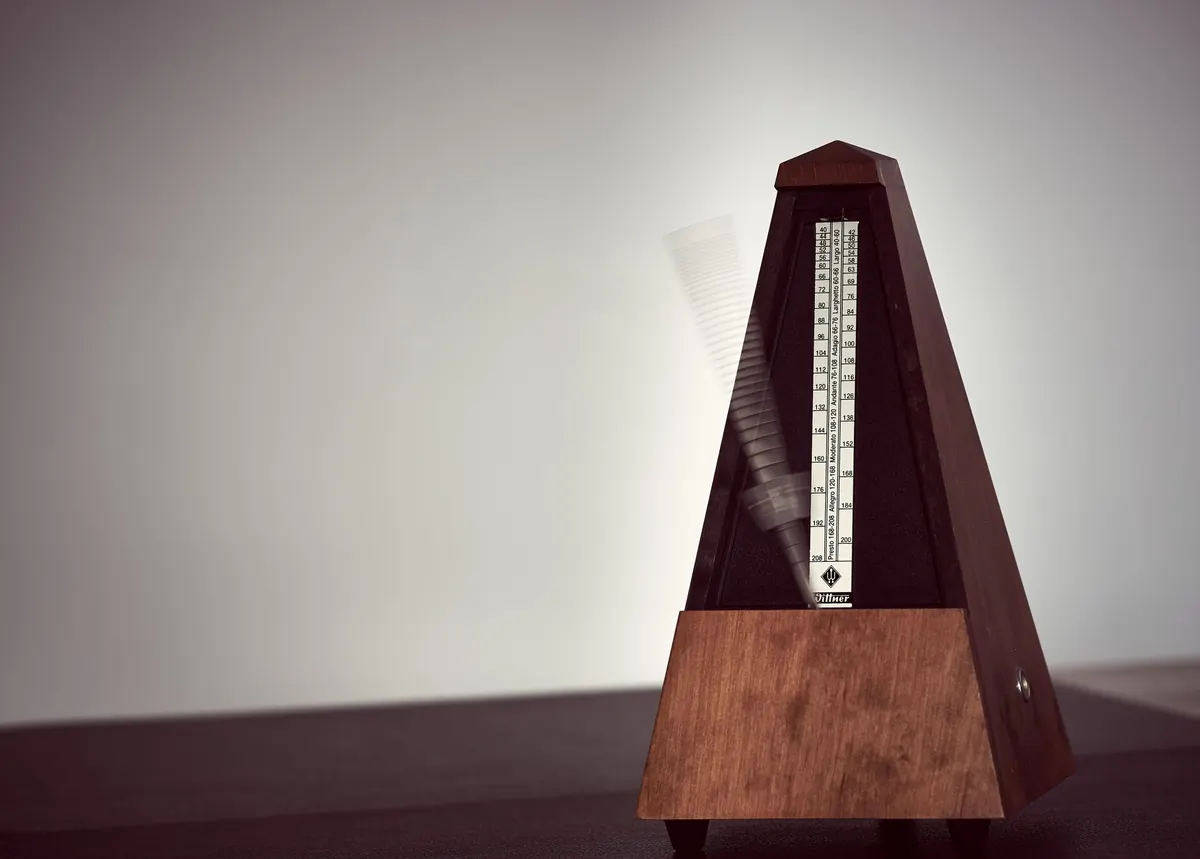
A metronome produces a steady pulse — click, beep or woodblock — at a tempo you choose. Set it to 60 BPM and you get one click per second. Most models, physical or app-based, let you accent the first beat of a bar so you can hear 3/4 from 4/4, subdivide the beat into eighths or triplets, and tap in a tempo you already have in your head.
Its job is not to make you faster. Its job is to make your timing audible and non-negotiable, so that rushing and dragging stop being invisible habits.
The tuner
A tuner measures the pitch you are producing and shows how far off you are, usually in cents. Clip-on models read vibration through the headstock, which is useful in a noisy room; app tuners use the microphone and work perfectly well in a quiet one. Most include a chromatic mode plus guitar, bass or ukulele presets, and a reference pitch you can shift from the standard A = 440 Hz.
Its job is to tell you, without judgement, what your ear cannot yet confirm.
The first-week reality: what breaks first
Something goes wrong in every beginner's first week, and it is rarely the thing they expected. The instrument drifts out of tune within minutes of playing. New strings stretch, rooms warm up and cool down, and the guitar that was fine at breakfast is noticeably flat by evening. On a bowed instrument, a slightly heavy hand on the peg does the same job in seconds.
Rhythm problems are quieter. Nothing sounds obviously broken. You simply slow down in the difficult bar and speed up in the easy one, and because you are the one playing, you do not hear it happening.
That asymmetry is the whole argument. A tuner solves a problem that is already there, on day one, in front of you.
Why the tuner usually comes first
Pitch is a gate. Practising on an out-of-tune instrument means your fingers learn positions that only sound right on that instrument in that moment, and your ear spends twenty minutes being trained on information you will have to unlearn later. Twenty seconds with a tuner removes the whole problem.
There is a second benefit that surprises people: a tuner teaches you what in tune feels like. Play a string slightly flat and you hear a slow waver against the reference. Nudge it until the waver disappears and you have just learned a sound, not a number on a screen. Do that every day for a month and your ear starts catching drift without the device.
For guitar, bass, ukulele and violin, tuning is also a physical skill. You are learning which way the peg goes, how far to turn, and why it helps to come up to the note from below rather than overshooting and backing down. That takes repetition, and repetition happens naturally when tuning is part of every session.
One caution: do not spend your practice time staring at the display. Tune, then put the tool down and play. Check again at the end of the session, when everything has settled.
Why the metronome earns its place just as fast
You can play every note in tune and still rush the third bar of a piece every single time. Rhythm errors do not announce themselves; they feel correct from the inside. A click is the cheapest honest feedback available.
It also changes how you practise, not just how you play. With a metronome running, the temptation to speed up through the section you know and muddle through the section you don't disappears, because the tempo is no longer yours to negotiate. You pick a speed where you can play the passage cleanly four times in a row, then move up by four or six BPM and repeat. That single habit prevents most of the mess that comes from practising mistakes at speed.
A tuner fixes the note in front of you. A metronome fixes the habit underneath it.
A sensible starting order for the first few months
This is the sequence that tends to stick, because it adds one new demand at a time:
- Week one — tuner only. Tune before every session, even a ten-minute one. Learn the pegs or the tuning menu, and get comfortable with the display.
- Week one — play freely for a few minutes first. No click, no counting, just sound. Beginners need a little unfussy contact with the instrument before anything gets measured.
- Week two — metronome on one exercise. One scale, one strumming pattern, one open-string exercise. Slow enough that it feels almost silly. Aim for accuracy, not speed.
- Weeks three and four — a full block with the click. Keep the tuner for the start and end of the session, and let the metronome run through a whole practice block, including the pieces you find easy.
- Month two — tune, click, record. Record thirty seconds on your phone. You will hear timing and tuning problems that neither device flagged on its own.
- Month three — use the features. Try accenting beats, subdividing eighths, and checking tuning halfway through a session once the instrument has warmed up.
Do you need two separate devices?
Not necessarily. Combination tuner-metronome units exist and take up one slot on the music stand, which is genuinely useful if space is tight. A clip-on tuner paired with a free metronome app is the cheapest sensible route, though phones bring notifications and distractions with them.
Two practical notes before you buy. First, a hardware metronome with a headphone output is easier to practise with than a phone speaker, especially on guitar where the click competes with the instrument. Second, check that the tuner's display is legible at a glance and that the clip holds firmly — a tuner that wobbles at the wrong angle gets abandoned within a week.
Fitting both into a five-minute session
Keep both tools on the stand or in the case, never in a drawer. Start with the tuner: open strings, thirty seconds, come up to pitch from below. Then set the click ten BPM slower than the tempo you think you can manage and play the hardest two bars four times. Add the rest of the piece at that same tempo. Finish by playing something you enjoy with no click at all, then give the instrument a quick tuning check and note the tempo you reached in a notebook so next time starts where this one ended.
If you can only buy one thing this week, buy the tuner and use a free click on your phone for a fortnight. Then add the metronome as a habit rather than a purchase — one exercise a day, slow enough to be boring, is enough to change how you play within a month.
Photo: Florian G / Pexels
Folding Music Stand Checklist: What to Test Before Rehearsal or a Gig
A practical pre-rehearsal and pre-gig check for folding music stands, covering joints, desk angle, feet,...

Back-to-School Practice Gear Checklist for Music Students
A practical, season-by-season checklist of the stand, folder, light, metronome, tuner, and bag a music...
About Us